

How to Order Custom Screen Printed Apparel
You've got a vision — maybe it's shirts for your fundraiser, uniforms for your crew, or merch for your brand. But if you've never ordered custom screen printed apparel before, the process can feel like a mystery. What files do you need? How much does it cost? How long does it take?
I've been the owner and operator of a commercial screen printing business since 2003. Over two decades, I've helped everyone from local nonprofits to the Mayor of Salem, Massachusetts bring their ideas to life on fabric. Here's everything I wish every customer knew before placing their first order — and exactly how to make the process smooth, affordable, and even fun.
Start With What You Have
The single best way to kick off an order is simple: show me what you've got. Maybe that's a polished logo file. Maybe it's a sketch on a napkin. Maybe it's just an idea rattling around in your head. Whatever stage you're at, start there, and ask your printer how to get the rest of the details together.
That said, the more prepared you are, the smoother (and faster) everything goes. Here's the gold standard for what to send your printer.
The Art: What We Need and Why It Matters
In a perfect world, you'll send us vector artwork. If you're not a designer, here's what that means in plain English:
A vector file is a type of digital image built from mathematical points and paths rather than tiny colored dots (called pixels). Think of it like a connect-the-dots drawing that a computer can scale up to billboard size or shrink to a business card without ever getting blurry. The most common vector file types are .AI, .EPS, .SVG, and sometimes .PDF.
Compare that to a regular image like a .JPG or .PNG — those are made of pixels. Zoom in or blow them up and they turn blocky and blurry, like looking at a photo through a screen door. For screen printing, vector files are ideal because we can cleanly separate each color and resize the design without losing a shred of quality.
The ideal vector file has:
Fonts outlined (converted to shapes so we don't need your specific font installed)
Strokes converted to outlines
All elements expanded
Saved to the actual print scale, with that scale noted in the file name
Don't have vector artwork? Don't panic. We work with what you've got. Here's the hierarchy of what else we can use:
Adobe Photoshop files (.PSD) — layered files are best, but even flattened ones can work.
High-resolution .TIFF or .JPG files — the key here is detail and size. If your file is large-scale and high pixel count, we can usually make it work. But if it's a one-inch-by-one-inch image and we need to print it at twelve inches across, it's simply too low-resolution. There's no magic button to fix that.
A pencil sketch or rough concept — we offer in-house art services. We'll work with you one-on-one to develop your vision into print-ready artwork.
The bottom line: don't let imperfect artwork stop you from reaching out. Just know that the closer your art is to print-ready, the faster you'll be holding finished shirts.
The Details: Your Printer's Wish List
When you reach out — whether by email or through a website quote form — the more detail you provide, the faster and more accurate your quote will be. Here's what we love to receive upfront:
Product brand, model, and item number (e.g., Gildan 2000)
Item color
Size list for each item and color (e.g., 5 Medium, 10 Large, 3 XL in Black)
Print position (front, back, left chest, sleeve, etc.)
Scale information (how large the print should be)
Any special effect inks — glitter, shimmer, foil, puff, glow-in-the-dark
Deadline date
Budget information
Pickup vs. shipping (and shipping address if applicable)
Anything else that helps us serve you — context about the event, the audience, the vibe
Think of it as a creative brief. The more love and intention you pour into that initial message, the richer your result will be.
Choosing the Right Garment
This is one of the most overlooked parts of the ordering process, and it matters more than most people realize. The garment is the canvas. It affects how the print looks, how it feels on the body, and what it costs.
When a customer asks me what shirt to pick, I usually start with a question: Is there a brand you already wear and like? Sometimes it's a brand we carry. If not, knowing the specs you prefer — fabric weight, fit, softness — helps me find something in our catalog that hits the same notes.
For most orders, I suggest Gildan products. They offer great pricing, consistent quality, and rock-solid availability. They've never had shortages in my experience — they're always in stock, always reliable. Their basic styles haven't changed in twenty years, which means you know exactly what you're getting every time. I also tend to recommend a basic fit since I can't always predict who the end user will be, and a classic cut works for the widest range of body types.
Of course, if you want a fashion-forward retail-quality blank or a performance fabric, we can source those too. But for the vast majority of orders — events, uniforms, fundraisers, promotions — Gildan is the sweet spot of quality and value.
What It Costs: Real Numbers, Not Guesswork
Pricing in screen printing can feel opaque if you've never ordered before, so let me give you actual figures. Here's what a straightforward order looks like:
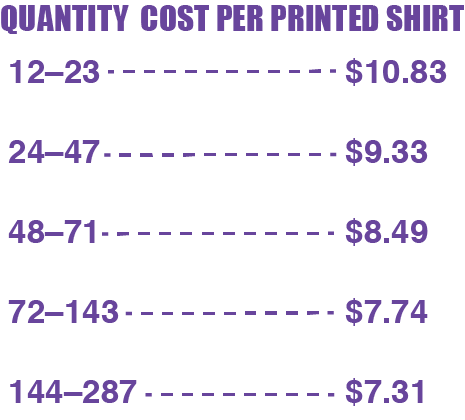
**One color, one print location (front), on a Gildan 2000 (100% cotton tee, sizes S–XL)
There's also a $25 setup fee per design — that stays the same regardless of quantity. Setup covers the screen preparation, which is a fixed cost whether you're printing a dozen or a thousand.
The main factors that drive price up or down:
Number of ink colors — each color requires its own screen and pass through the press
Number of print locations — front only is one setup; front and back is two
Quantity per design — the more you print, the lower your per-unit cost
Garment cost — a premium tri-blend blank costs more than a standard cotton tee
How Long It Takes
Two weeks is our standard turnaround from the time everything is locked in — approved quote, final artwork, complete size list, and deposit payment.
The things that slow orders down are almost always on the communication side: delays in approving the quote, changes to the size list after production starts, waiting on final art approval, or late payment. The faster you lock in those details, the faster you're wearing your shirts.
A Story From the Press: The Salem Snowmaritans
In February 2015, Salem, Massachusetts got hammered by a series of blizzards. Snow days piled up and the city was buried. But during the chaos, something beautiful happened — people started helping each other. Digging out neighbors' cars. Checking on elderly residents. Clearing sidewalks they didn't have to clear.
The office of then-Mayor Kim Driscoll took notice. She wanted to create a program to recognize and reward these everyday heroes — a way for community members to nominate good doers and give them something tangible as a thank-you. She reached out to me because we'd worked together on shirt projects before.
We landed on a Gildan 2400 long sleeve in navy — perfect for the brutal New England winter they were still slogging through. I offered a discount in exchange for including my logo on the piece, and then I got to work helping shape the whole concept.
I suggested the name: "Snowmaritan" — a play on Good Samaritan. The mayor loved it, and it stuck. For the design, we created a graphic of a witch (Salem's iconic symbol) face-first in a snowbank, her entire body buried with only her striped socks poking out. We printed the City of Salem logo on the front left chest and "I'm a Salem Snowmaritan" on the back alongside the buried-witch graphic in white and baby blue ink.
The shirts were a massive hit. People loved getting nominated, loved wearing them, and the whole program ended up making the front page of the local newspaper. It was one of those projects where everything clicked — the right garment, a fun concept, a community that rallied around it, and a product people were genuinely proud to wear.
That's what happens when a customer comes to the table with intention and energy. We're not just pressing ink onto fabric. We're building something together.
The Philosophy: Love In, Love Out
Here's the thing I wish every customer understood before their first order:
We are hand-craft artisans of printed material. Every step of our process is painstakingly executed with scrutiny, intention, and love. We take pride in making great-looking apparel with the goal of adding excitement, color, and value to campaigns, storefronts, and fundraisers.
The more love and intention you provide us, the deeper and richer your end result will be.
Love in, love out.
So have fun with it. Bring your ideas, your energy, your excitement. Your intention and effort will show through to the final product — so make it count.
Ready to Get Started?
Show us what you have. Ask us how to get the rest. That's all it takes to begin.
